Snapchat Planets: Order, Meanings & Friend Solar System Explained

Snapchat Planets are the eight planet icons — Mercury through Neptune — that appear inside a Friend Solar System, a Snapchat+ feature built on top of the Best Friends list. Each planet marks a ranked position, not a literal planet or a measurement of feelings. This guide walks through the order, what every position means, and the questions people actually ask after they see one on their screen.

  • Eight planets, eight ranked positions — Mercury is first, Neptune is last
  • Friend Solar System is associated with Snapchat+, built from someone's Best Friends
  • A planet position is one-directional — it isn't automatically mirrored back to you

Friendship position, Mercury to Neptune

Quick answer

Snapchat Planets in order

If you only need the order, here it is. Everything else on this page expands on what these positions actually mean.

MercuryMercury VenusVenus EarthEarth MarsMars JupiterJupiter SaturnSaturn UranusUranus NeptuneNeptune
  • #1 Mercury — first position, closest to the center of the ranking
  • #2 Venus — second position
  • #3 Earth — third position
  • #4 Mars — fourth position, the midpoint
  • #5 Jupiter — fifth position
  • #6 Saturn — sixth position
  • #7 Uranus — seventh position
  • #8 Neptune — eighth and final position

Each number is a rank, not a distance or a score out of ten. Mercury being "first" mirrors how Mercury is the planet closest to the sun in an actual solar system — it's a naming device, not a claim about physical closeness or emotional intensity.

The concept

What are Snapchat Planets, exactly?

Snapchat Planets are the visual identifiers used inside a Friend Solar System, a Snapchat+ feature that maps someone's eight Best Friends onto a set of planets. Snapchat has long kept a private Best Friends list for every account — the people a user Snaps and Chats with the most. The Solar System takes that same list and gives each of the eight spots a planet, arranged in order from Mercury to Neptune.

The metaphor borrows the layout of our actual solar system, where Mercury orbits closest to the sun and Neptune sits farthest out. Snapchat reuses that ordering as a simple way to represent rank: Mercury is first, Neptune is eighth. It isn't a statement about distance, size, or how "important" a planet looks — Jupiter is the largest planet in real life, for instance, but its size in the feature carries no extra meaning about the friendship it represents.

Two ideas make the feature easy to misread if you skip them. First, a Friend Solar System belongs to one account. When you open your own Solar System, you're looking at your eight closest interaction partners, represented as planets. When a friend has their Solar System visible to you, you may be able to see where you land in theirs. Second, the ranking is based on the same signal Snapchat has always used for Best Friends — frequency and pattern of Snapping and chatting — not a manually chosen list. Nobody drags and drops names into planet slots.

The feature is tied to Snapchat+, Snapchat's paid subscription tier, and it isn't switched on the moment you subscribe. According to Snapchat's own support documentation, Solar System is off by default for first-time subscribers: you turn it on yourself from the Snapchat+ feature management page in your profile, and you can switch it off again at any time. That toggle explains a lot of the confusion people run into — a Snapchat+ subscription alone doesn't guarantee you'll see planets on your own or a friend's profile.

Snap Inc. has also said publicly that Solar System is used by a small share of the Snapchat+ community — under 0.25% of the community on an average day, by the company's own figures. It's a niche, optional layer on top of Best Friends, not a feature every subscriber turns on.

You Interact with a friend Their Friend Solar System Your planet position

Snapchat Planets order — the complete table

The table below lists all eight positions in order, along with what each position represents on its own. It intentionally avoids assigning emotional labels that Snapchat has never attached to the feature.

Snapchat Planet order and position meaning
PlanetPositionWhat the position represents
Mercury#1Highest-ranked position among the eight Best Friends in that Solar System
Venus#2Second-highest position
Earth#3Third position
Mars#4Fourth position, the midpoint of the eight
Jupiter#5Fifth position
Saturn#6Sixth position
Uranus#7Seventh position
Neptune#8Eighth and final position, still inside the Best Friends group
Try it

Interactive planet explorer

Select any planet to see its position and a quick, accurate explanation. Every planet is also covered in full below, so this works whether or not JavaScript is enabled.

Mercury, a Snapchat Friend Solar System planet
Position #1

Mercury

Mercury marks the first position in a Friend Solar System. If you see Mercury next to someone's name, you occupy the top spot among the eight Best Friends represented in their Solar System.

Common misunderstanding: Mercury only reflects one person's Solar System. It doesn't automatically mean you hold the same position in reverse.

Prefer not to use the interactive version? Every planet is explained in full detail in the section below.

In depth

The eight Snapchat Planets, one at a time

Each planet gets its own explanation below, with a different angle for every position so this doesn't read like the same paragraph copied eight times.

Mercury, the first position in a Snapchat Friend Solar System Position #1

Why do I have Mercury next to my friend's name?

Mercury

Because you rank above their other seven Best Friends. Mercury is the first and highest position in a Friend Solar System, and seeing it next to a friend's name means Snapchat's Best Friends signal currently puts you ahead of everyone else represented in that person's Solar System.

One detail is easy to miss: Mercury describes your position in their Solar System — the account you're viewing. It says nothing about how they rank in yours, which is covered further down this page.

Example: if you open a friend's profile and see yourself represented as Mercury, that reflects how frequently and consistently the two of you have been Snapping and chatting relative to their other seven Best Friends — not a title Snapchat has permanently assigned to the friendship.

Venus, the second position in a Snapchat Friend Solar System Position #2

Am I still close to them if I'm Venus, not Mercury?

Venus

Venus is the second position, immediately behind Mercury. The gap between the two is a ranking difference, not a defined amount of interaction — Snapchat hasn't published how close a Mercury-level interaction pattern needs to be to a Venus-level one.

In practice, Venus still represents a very active friendship. Being second out of eight Best Friends puts you well ahead of the large majority of someone's contacts, even if it isn't the single top spot.

Example: a friend you talk to daily but slightly less than your single most-active contact would typically land around Venus rather than Mercury.

Earth, the third position in a Snapchat Friend Solar System Position #3

Does being someone's "Earth" mean anything special?

Earth

No. Earth sits in third place, directly below Venus and above Mars, and it doesn't carry any special significance beyond that. Some users assume "home planet" implies a default or default-feeling friendship — Snapchat has never described it that way.

A friend shown as Earth is still solidly inside someone's top three interaction partners out of everyone they Snap and Chat with, which is a meaningfully close position even without being first.

Example: Earth is a normal position for a close friend you talk to often but who shares your attention with one or two other very active contacts.

Mars, the fourth position in a Snapchat Friend Solar System Position #4

Is Mars a warning sign?

Mars

No. Mars is the fourth position — the exact midpoint of the eight. It's easy to read the red color as some kind of warning, but that's a coincidence of the planet's real-world appearance, not a signal Snapchat has built into the feature.

Being ranked fourth still means you're inside the top half of someone's Best Friends, ahead of four other people represented in the same Solar System.

Example: a friend you Snap with regularly, but less consistently than your top three contacts, commonly sits around Mars.

Jupiter, the fifth position in a Snapchat Friend Solar System Position #5

Does Jupiter's size mean I matter more?

Jupiter

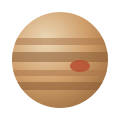
No. Jupiter is the fifth position. In our actual solar system, Jupiter is by far the largest planet — and that fact sometimes leads people to assume a bigger illustration must mean a bigger or more important friendship. It doesn't. The planets are a recognizable, ordered set of icons; visual size in any illustration (including the ones on this page) is not part of Snapchat's ranking.

Position five means the friendship is still active enough to place inside the top eight, just past the midpoint of the ranking.

Example: Jupiter is common for a friend you interact with somewhat regularly, but less often than the four people ranked above them in that Solar System.

Saturn, the sixth position in a Snapchat Friend Solar System Position #6

Do Saturn's rings mean the friendship is ending?

Saturn

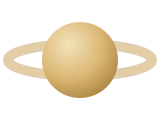
No. Saturn is the sixth position, easy to spot because of its rings. Those rings exist so Saturn is instantly recognizable in a lineup of eight planets — they don't represent a boundary, a limit, or a friendship "closing off," despite how tempting that reading can be.

Sixth position still places a friend inside someone's top eight interaction partners, even though it's closer to the lower end of that range.

Example: Saturn typically shows up for a friendship that's real and ongoing, but with less frequent Snapping than the five positions above it.

Uranus, the seventh position in a Snapchat Friend Solar System Position #7

Does a low position mean the friendship isn't real?

Uranus

No. Uranus is the seventh position, one of the two lowest ranks among the eight. Landing here can feel discouraging if you were expecting a higher spot, but a Solar System only has eight slots total — being seventh still means you outrank everyone outside that top eight.

A drop to Uranus usually points to reduced interaction frequency relative to other friends, rather than any single dramatic event.

Example: a friendship that used to be very active but has cooled to occasional messages might move down toward Uranus over time.

Neptune, the eighth position in a Snapchat Friend Solar System Position #8

Does Neptune mean we're basically not friends?

Neptune

No. Neptune is the eighth and final position in the Solar System. It's the lowest rank shown, but it's still one of only eight spots out of potentially hundreds of contacts on someone's account — being visible as Neptune means you're still inside their Best Friends group, not outside it.

If a friend moves to Neptune or drops out of the Solar System entirely, that reflects a change in relative interaction frequency, which is covered in more detail in the "why did my planet change" section below.

Example: Neptune is common for a friendship that's still active, but shares attention with seven other people who currently interact with that account more often.

Interpreting your planet

What your Snapchat Planet actually tells you

Once you know which planet you've been assigned, the natural next question is what to do with that information. The honest answer is: treat it as a ranking, not a verdict. A planet position reflects Snapchat's read on interaction frequency between two accounts — how often and how consistently you Snap and Chat compared with someone's other Best Friends. It isn't a statement issued by the other person, and it isn't something either of you directly controls by hand.

That distinction matters most in two situations people search for constantly: whether the ranking runs in both directions, and whether it says anything about feelings beyond friendship.

Can someone be your Mercury while you're their Neptune?

Yes, and it's more common than people expect. A Friend Solar System is built from one account's interaction pattern at a time. Your Solar System is generated from your Snapping and chatting habits across all of your contacts; a friend's Solar System is generated the same way, but from their habits. If you message that friend constantly while they split their attention across many more people, you can easily be their Mercury while they're much further down your own list, or not in your top eight at all.

Neither direction "overrides" the other. Both are accurate readings of two different interaction patterns.

Do Snapchat Planets show romantic feelings?

No. The planet system represents a position inside Snapchat's Best Friends interaction ranking — nothing more. It is not a documented measurement of love, attraction, loyalty, or relationship status, and Snapchat has never described it that way. Snap Inc. itself has acknowledged that seeing a ranking like this can feel bad even when nothing is wrong, which is one reason Solar System shipped as an optional, opt-in feature rather than something switched on for everyone.

If you're trying to understand how someone feels about you, a planet icon isn't designed to answer that — a conversation is.

Snapchat has also spoken directly to this: after early feedback that Best Friends, Streaks, and Solar System were adding pressure to some users — teens in particular — the company changed Solar System from on-by-default to off-by-default, so people have to choose to see it. Read Snap's full statement ↗.

Snapchat Planets vs. Best Friends vs. Extended Best Friends List

Three separate ideas get blended together in most explanations of this feature, and keeping them apart clears up most of the confusion. Best Friends is the underlying ranking Snapchat has always kept. Friend Solar System is the planet-based way of viewing where you land inside someone else's Best Friends. Extended Best Friends List is a different Snapchat+ feature entirely: instead of planets, it shows a plain list of your own current eight Best Friends, your next eight Upcoming Best Friends, and any movement up or down since you last checked — accessed through My Account → My Friends, and toggled on separately from Solar System. In short, Solar System shows your rank inside someone else's list; Extended Best Friends List shows the full shape of your own.

How Best Friends, Friend Solar System, and Extended Best Friends List relate
FeatureWhat it isAvailability
Best FriendsThe underlying list of the eight accounts a user Snaps and Chats with mostLong-standing Snapchat mechanic
Friend Solar SystemA visual layer that shows your position in someone else's Best Friends as one of eight planetsSnapchat+, off by default until toggled on
Extended Best Friends ListA list view of your own current and Upcoming Best Friends, with movement tracking — no planets involvedSnapchat+, toggled independently of Solar System
Troubleshooting

Why did my Snapchat Planet change?

Planet positions move when the underlying interaction pattern moves. A few realistic reasons this happens:

  • Your own interaction pattern shifted. Snapping or chatting more or less than usual with a specific friend can move your position up or down.
  • Someone else's position shifted. Because there are only eight slots, another friendship becoming more active can push your rank down even if your own behavior hasn't changed.
  • Snapchat updated the feature. Snapchat periodically adjusts app features, and the Friend Solar System is no exception.
  • The ranking system isn't fully public. Snapchat has not published an exact formula, threshold, or Snap count required to hold any specific position, so small changes in rank aren't always explainable from the outside.

A planet moving down doesn't necessarily mean someone deliberately did something to change the friendship. It's most often the ordinary result of interaction patterns naturally fluctuating over time.

How the feature works

How to see your Snapchat Planet

This is the general process. Snapchat periodically changes labels, icon placement, and navigation, so treat this as a guide to the concept rather than a pixel-exact walkthrough.

  1. Make sure the account has an active Snapchat+ subscription, since Friend Solar System is a Snapchat+ feature.
  2. Open the Snapchat+ feature management page from your profile and switch the Solar System toggle on — it's off by default for first-time subscribers.
  3. Open the relevant friend's Friendship Profile.
  4. Look for a "Best Friends" badge with a gold ring around it. Snapchat shows this badge when that friend is among the eight people you Snap and Chat with the most.
  5. Tap the badge to reveal the planet that represents your position in their Solar System.

SnapchatPlanet.tech is an independent reference site. We can't look up, reveal, or predict any individual account's planet — that information only exists inside Snapchat itself, tied to the account holder's Snapchat+ subscription.

Troubleshooting

Why can't I see Snapchat Planets?

If the Friend Solar System isn't showing up, a few common causes are worth checking before assuming something is broken:

  • No active Snapchat+ subscription. This is the most common reason the feature is missing entirely.
  • Outdated app version. Update Snapchat, since older versions may not include the current Friend Solar System interface.
  • Feature rollout differences. Snapchat doesn't always release every Snapchat+ feature to every region or account at the same time.
  • Friendship profile context. The Solar System display is tied to specific Friendship Profiles, so it may not appear the same way in every part of the app.
  • The other account's settings. What you can see may also depend on choices made on the other person's account, not just your own.

If none of these explain what you're seeing, Snapchat's own support channels are the right place to check, since they have direct access to account-level information that an independent site like this one does not.

Frequently asked

Snapchat Planets FAQ

What are Snapchat Planets?

They're the eight planet icons used inside a Friend Solar System to represent your ranked position among someone's eight Best Friends on Snapchat.

What is the Snapchat Planet order?

Mercury, Venus, Earth, Mars, Jupiter, Saturn, Uranus, Neptune — from first position to eighth.

What does Mercury mean on Snapchat?

Mercury is the first and highest position in a Friend Solar System.

What does Venus mean on Snapchat?

Venus is the second position, just behind Mercury.

What does Earth mean on Snapchat?

Earth is the third position in the ranking.

What does Mars mean on Snapchat?

Mars is the fourth position, the midpoint of the eight.

What does Jupiter mean on Snapchat?

Jupiter is the fifth position. Its size in the illustration has no bearing on the ranking.

What does Saturn mean on Snapchat?

Saturn is the sixth position. The rings are a visual identifier only.

What does Uranus mean on Snapchat?

Uranus is the seventh position, one of the two lowest ranks in the Solar System.

What does Neptune mean on Snapchat?

Neptune is the eighth and final position, still inside someone's Best Friends group.

Are Snapchat Planets only for Snapchat+?

Yes. Friend Solar System is a Snapchat+ feature, and it's also off by default even for subscribers — it has to be turned on from the Snapchat+ feature management page.

What's the difference between Solar System and Extended Best Friends List?

Solar System shows your planet position inside someone else's Best Friends. Extended Best Friends List is a separate, list-based Snapchat+ feature showing your own current and Upcoming Best Friends, with no planets involved.

How many Snapchat Planets are there?

Eight, matching the eight positions in someone's Best Friends list.

Does Mercury mean someone is your #1 Best Friend?

Mercury means you hold the first position in that specific person's Solar System — it reflects their interaction pattern with you, not automatically your ranking of them.

Can Snapchat Planets change?

Yes. Positions shift as interaction patterns and other friendships change.

Why did my Snapchat Planet change?

Usually a shift in interaction frequency — yours or another friend's — rather than one specific event. See the section above for more detail.

Can someone be my Mercury while I am their Neptune?

Yes. Each Solar System is generated from one account's own interaction pattern, so the two directions can differ.

Do Snapchat Planets indicate romantic feelings?

No. The feature is not a documented measurement of romantic interest or relationship status.

Can I see someone's planet without Snapchat+?

No. Solar System requires an active Snapchat+ subscription, and it has to be manually toggled on before it works at all.

Are Snapchat Planets the same as Best Friends?

They're related but not identical — Best Friends is the underlying list, and the Solar System is the planet-based way of displaying it.

Does planet size have a meaning?

No. Visual size is only there to make each planet recognizable, not to signal anything about the friendship.

Does Saturn's ring mean anything?

No documented meaning beyond making Saturn easy to identify at a glance.

Why can't I see Friend Solar System?

Most often a missing Snapchat+ subscription, an outdated app version, or a regional feature rollout — see the troubleshooting section above.

Is the Snapchat Planet ranking permanent?

No. It reflects an ongoing interaction pattern, so it can move over time.

Does Snapchat reveal the exact ranking algorithm?

No. Snapchat has not published an exact formula or threshold for how positions are calculated.

Sources & fact-checking

Where this information comes from

Factual claims about how Best Friends, Friend Solar System, and Extended Best Friends List work are checked directly against Snapchat's own support documentation and Snap Inc.'s public statements. Snapchat can change feature names, availability, and interface details over time, so parts of this page are reviewed periodically rather than written once and left untouched.

Primary sources used for this guide: How do Friend Solar Systems work? ↗, Extended Best Friends List ↗, and Snap's newsroom statement on Best Friends, Streaks, and the Solar System ↗.

About this guide

Why SnapchatPlanet.tech exists

Purpose
To explain Snapchat's Friend Solar System clearly in one place, instead of scattered across forum threads and short clips.
Editorial approach
Written and reviewed by Ayaz Thebo, an independent editor with no affiliation to Snap Inc.
Fact-checking
Claims are checked against Snapchat's official support documentation; anything not publicly confirmed is labeled as such rather than guessed at.
Last updated
August 2026 — see our Editorial Policy for how updates are handled.